
How WAB2C Turns WhatsApp Into a Product Verification and Anti-Counterfeit Evidence Network
One code. One WhatsApp conversation. A growing picture of where suspicious products are appearing, how often they are being checked and what evidence customers can provide.
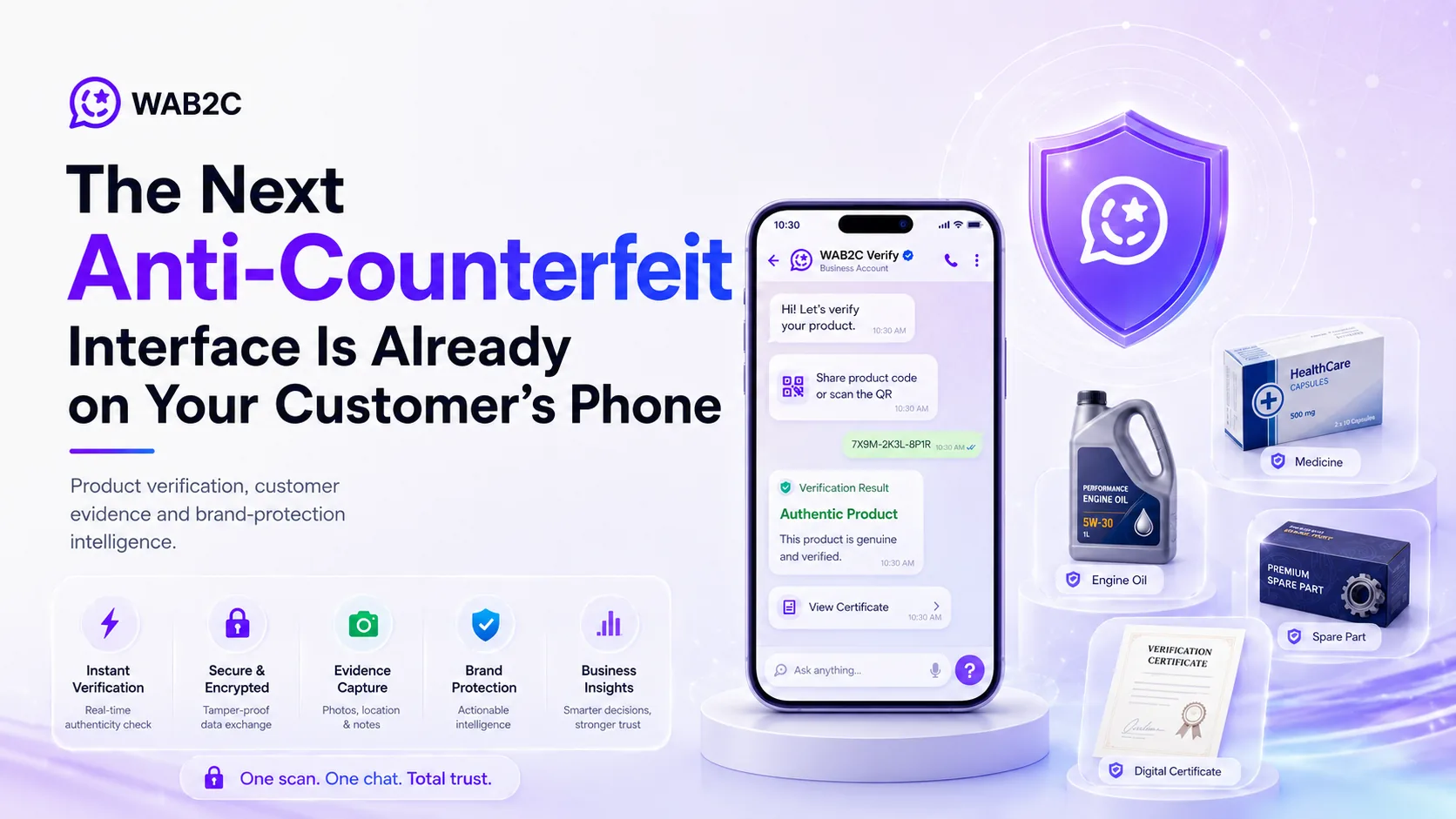
The next anti-counterfeit interface may already be on your customer’s phone.
- Written by
- WAB2C Research Team
- Product verification and implementation research
- Published
- Reading time
- 17 min read
On this page
Counterfeit investigations begin with customer doubt
A counterfeit investigation rarely begins in a laboratory or a courtroom. It usually begins with a small moment of doubt.
A patient notices that the printing on a medicine pack looks different. A customer opens a beauty cream and finds that its colour or smell is unfamiliar. A workshop receives an engine-oil container with a cap that does not feel right. A mechanic is handed a spare part in convincing packaging, yet the finish appears slightly wrong. An employer receives a degree or training certificate and wants to know whether the issuing institution ever produced it.
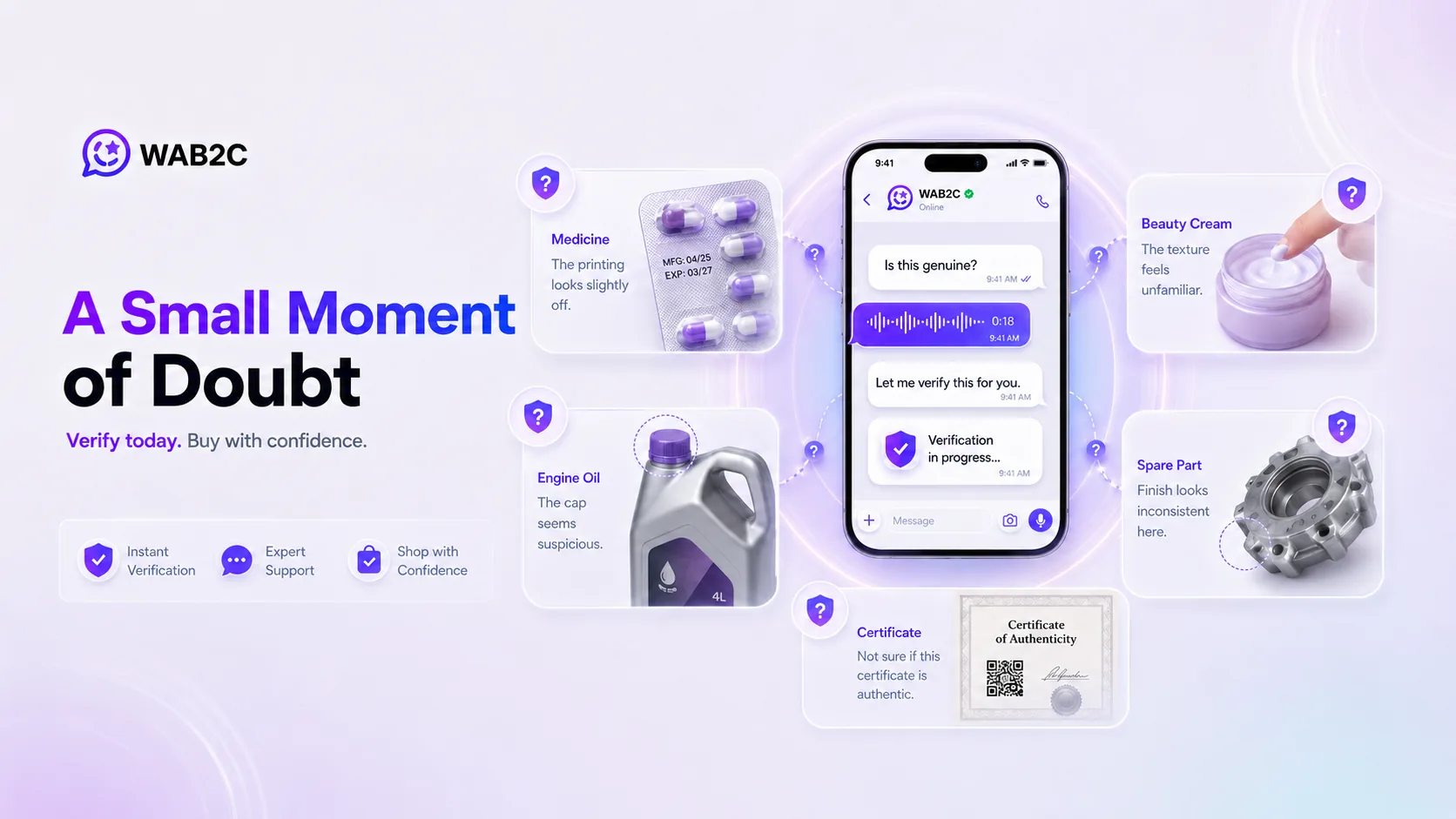
The person holding the item is not an investigator. They may not know which hologram to inspect, which website to trust or which department to call. They simply want an answer to one urgent question: Is this genuine?
Traditional authentication often treats that question as a one-time inspection. But the customer may be holding the first visible piece of a wider distribution pattern. The serial, seller, receipt, package photographs, location and timing of the check can help a brand understand whether the same supposedly unique item is appearing elsewhere.
One unique code starts a WhatsApp verification. Every repeated check, location signal, customer photograph, receipt, seller report and conversation can contribute to a structured investigation.
WAB2C uses WhatsApp as the familiar public entry point and connects it to a protected product registry, verification service, repeat-check rules, Team Inbox and case workflow. The objective is not merely to show a reassuring tick. It is to make every legitimate check useful and every unusual pattern easier to review.
Counterfeiting is a safety, trust, revenue and data problem
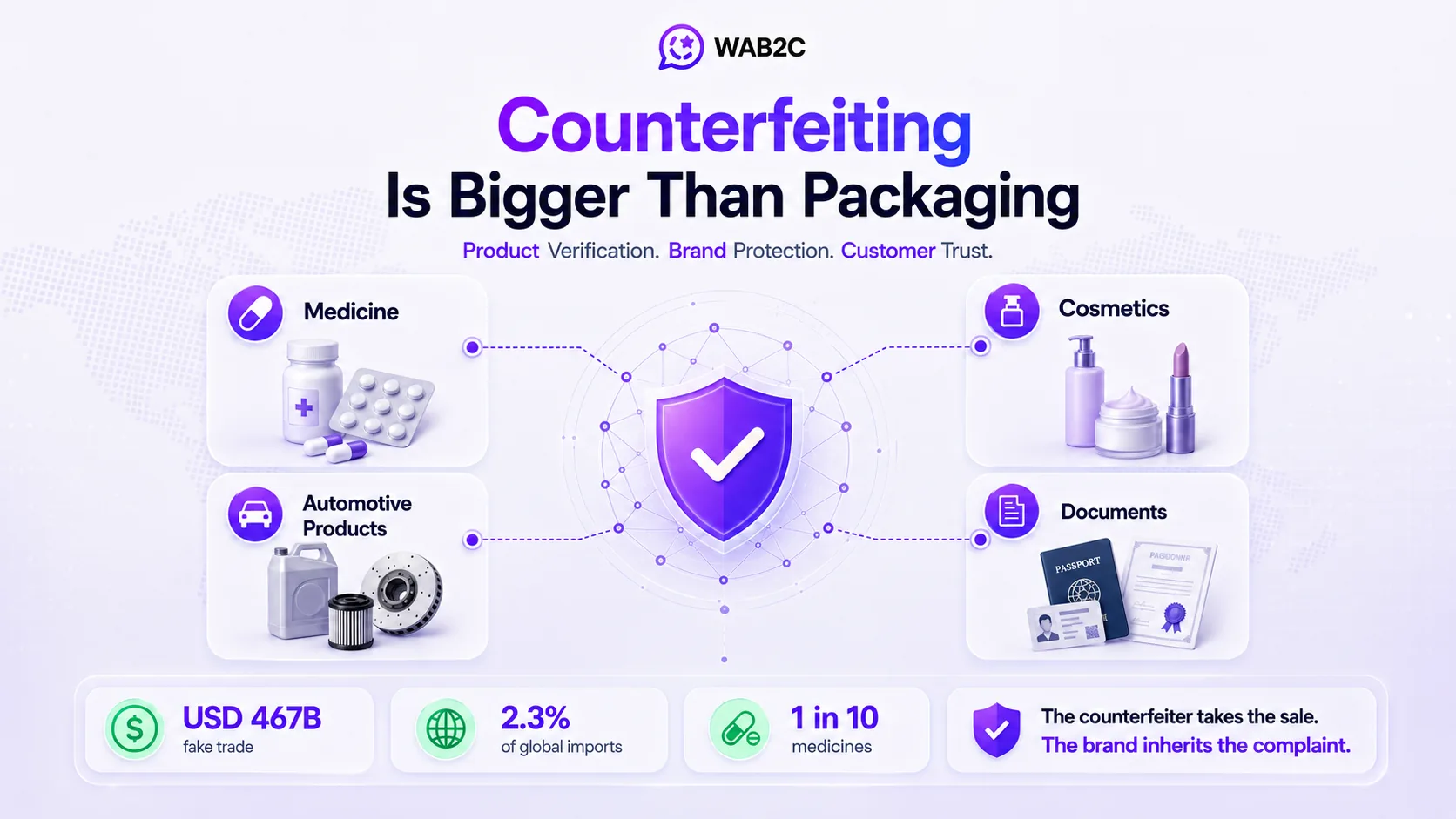
Counterfeiting is often described as a lost-sales problem. That is true, but incomplete. It exposes customers to goods that were never subject to the genuine manufacturer’s controls, damages brand trust, diverts revenue and obscures what is happening in distribution.
USD 467B
Estimated value of counterfeit and pirated goods in world trade in 2021
OECD/EUIPO · 2025 report ↗
At least 1 in 10
Medicines in low- and middle-income countries is substandard or falsified
World Health Organization ↗
3B+
People in more than 180 countries use WhatsApp
Meta · 2025 ↗
The risk is sharpest in healthcare. Substandard and falsified medicines may contain incorrect ingredients, the wrong amount of an active ingredient, or no active ingredient at all. Pakistan’s Drug Regulatory Authority publishes recall and rapid alerts that show why field information—product, batch, expiry, packaging differences, seller, place and time—matters.
The same logic extends beyond medicines. Fake cosmetics may contain unsuitable ingredients. Counterfeit oil can damage an engine after the container is discarded. An imitation brake part creates a safety risk. A false certificate can transfer trust to someone who has not earned it. The counterfeiter takes the sale; the genuine brand often inherits the complaint.
Verification succeeds only when customers participate
A technically impressive system fails if the public does not use it. Downloading an unfamiliar application, creating an account, finding a scanner, calling during office hours or formatting an SMS all add friction at the moment a customer is already uncertain.
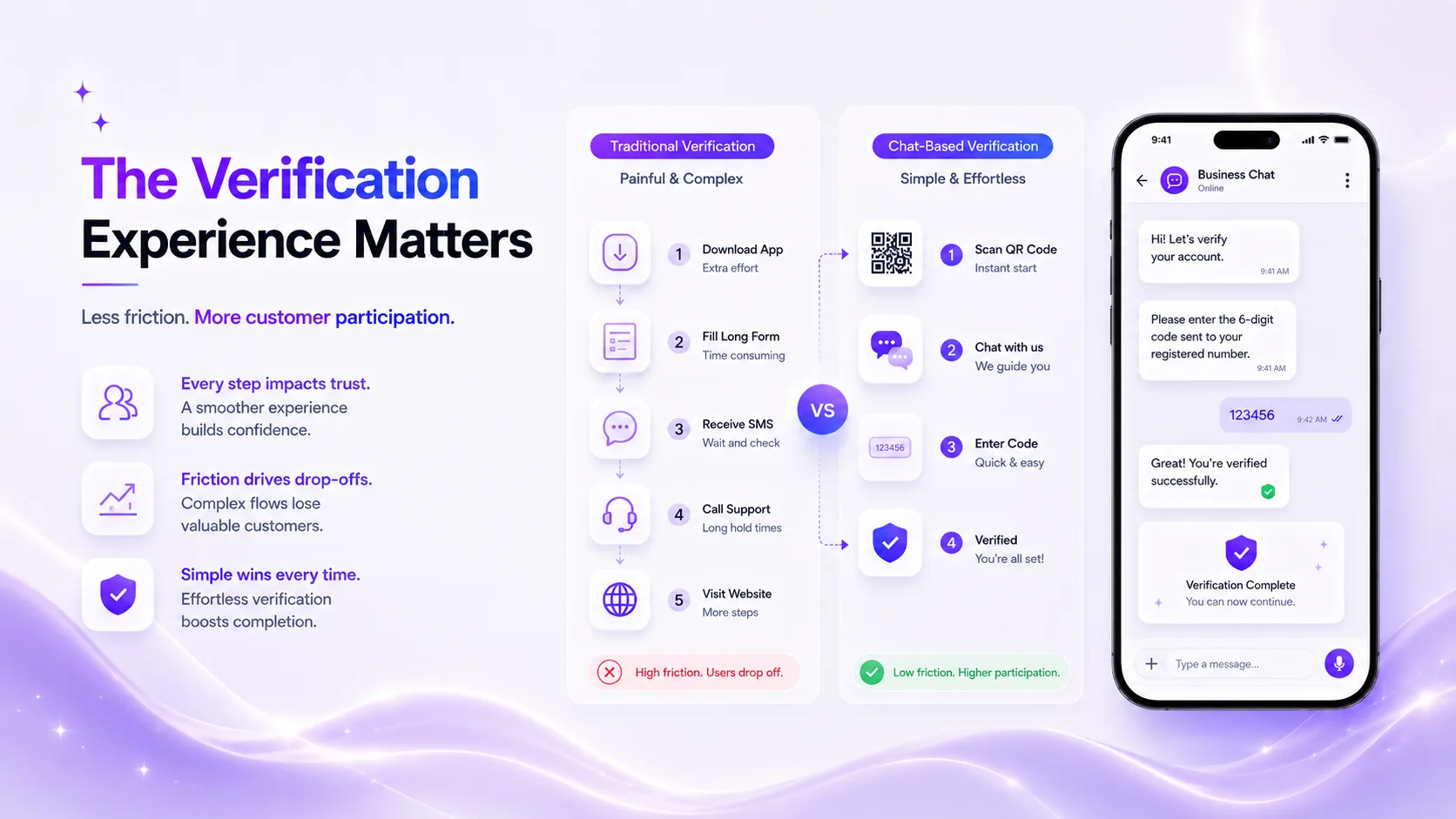
WhatsApp begins from behaviour that already exists. A customer can scan a code that opens an official business conversation, type the unique serial, or send a photograph. The flow can respond with short text and buttons. If a result requires review, the same thread can ask for packaging photographs, a receipt, seller details, optional location, video or a voice note.
That last format matters. Meta reported that people were sending an average of seven billion voice messages on WhatsApp every day in 2022. Voice can make reporting more accessible when a customer finds it difficult to type a visual difference or purchase story.
WhatsApp is the interface—not the source of truth.
The decision must come from the brand’s trusted registry and approved rules. WAB2C provides the automation and implementation layer connecting conversation, data and human action. Its provider disclosure explains its provider-flexible role.
The result is credible because the official business number, item identity, protected registry and disciplined investigation process work together—not because a WhatsApp logo appears on the pack.
Part number, SKU, batch and unique serial are not interchangeable
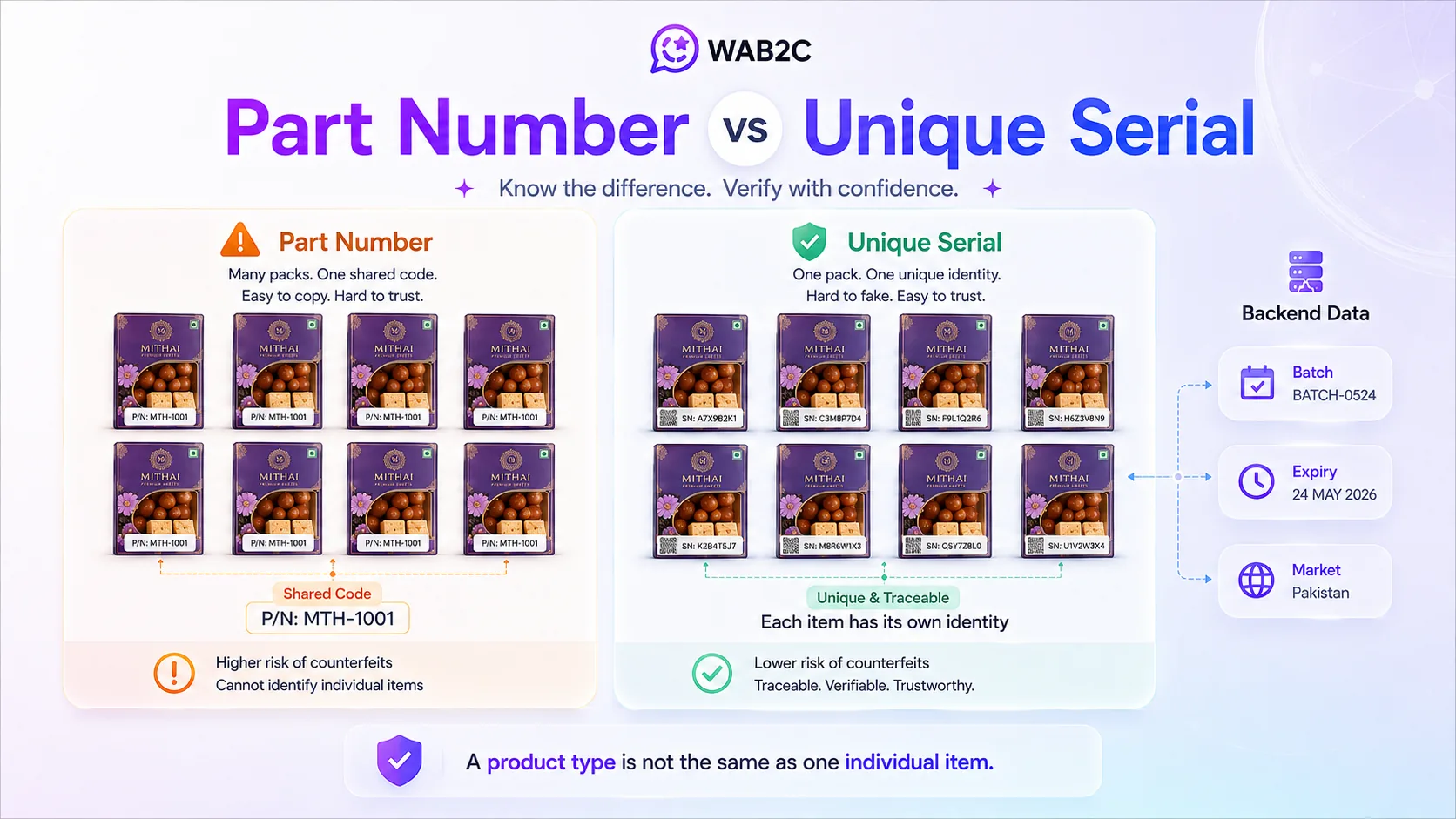
Part number
Identifies a component design or product type. Many physical items can share it.
SKU
A merchant’s inventory identifier for a sellable variant, such as size, colour or pack.
Batch or lot
Groups items made, processed or released together. Useful for recalls, but shared across many units.
Unique item serial
Identifies one individual saleable unit or pack and supports item-level history.
If every hair-oil bottle carries the same product code, a counterfeiter can copy it onto thousands of bottles. A static QR has the same weakness when it simply opens one public page. The backend confirms that the product type exists, but learns nothing about the individual physical item.
A stronger implementation assigns a unique, difficult-to-guess serial to every saleable item or pack. The registry connects that identifier to product, batch, manufacture and expiry dates, pack size, intended market, distributor, release status, recalls and previous checks. The serial can be human-readable and encoded in a QR, Data Matrix or barcode.
Item-level identity aligns with established traceability thinking. FDA product-identifier guidance describes pharmaceutical identifiers containing product code, serial, lot and expiration data. The GS1 Global Traceability Standard provides a broader framework for identifying, capturing and sharing traceability information.
A unique serial can still be copied. Its strength comes from the registry remembering what happens next: first check, subsequent checks, timing, customer diversity, territory and connected evidence.
The customer verification journey
The strongest flows feel simple because complexity remains behind the screen.
- Start: the customer scans a code or messages the official brand number.
- Capture: WAB2C accepts typed text or an image and normalises permitted spaces and dashes.
- Check: the verification API queries the authorised registry without exposing internal records.
- Explain: the flow returns a carefully defined status and an appropriate next action.
- Enrich: unusual or unknown results trigger progressive evidence requests.
- Escalate: the complete conversation, registry result and checklist move into the Team Inbox.
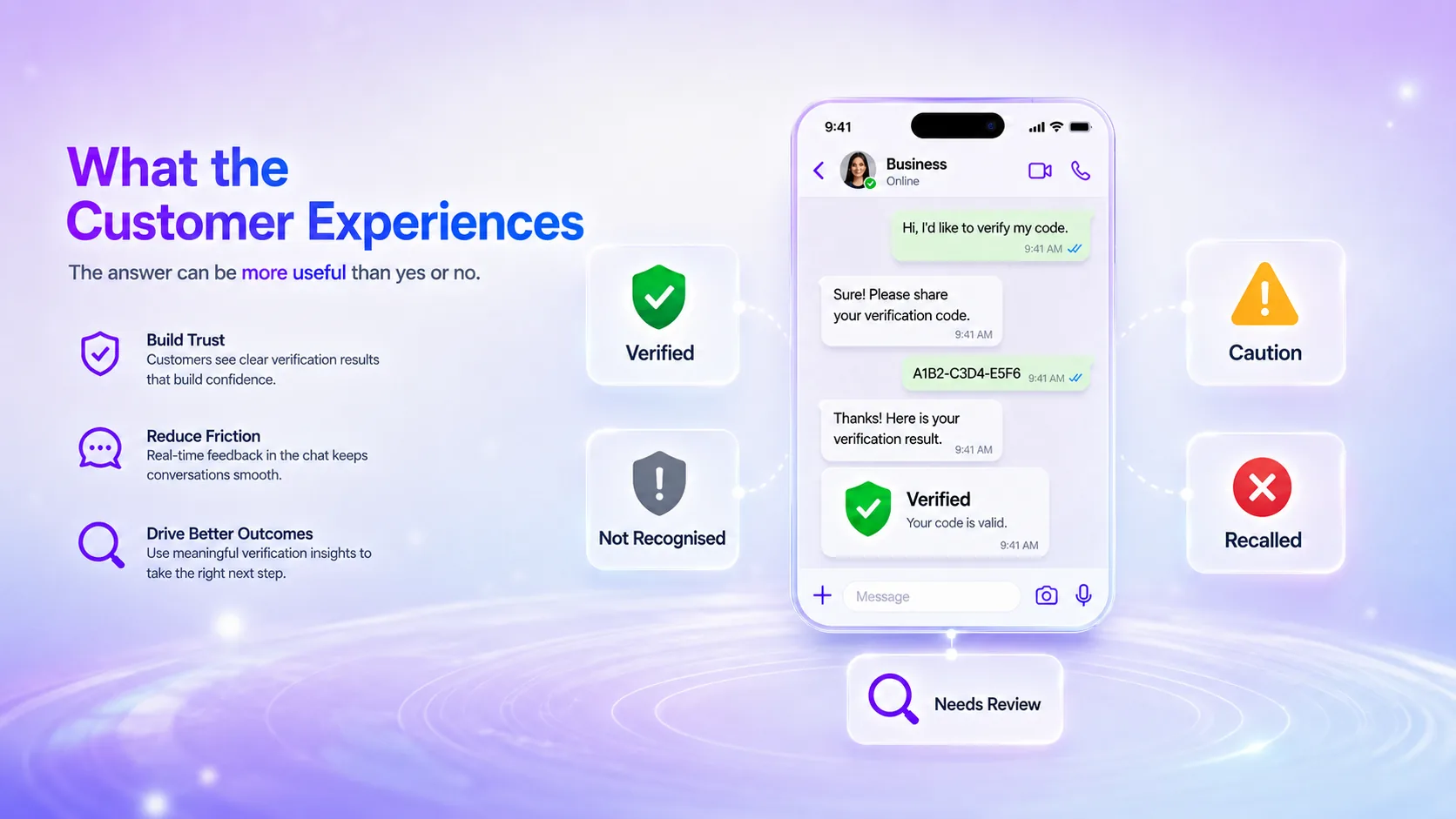
Verification status design
A binary valid/invalid response is often too crude. Clear wording reduces panic, avoids false accusations and tells the customer what to do next. Each state below uses a label and icon as well as colour.
Verified — first recorded check
Registry match; first recorded customer verification.
Verified — same customer
A previous check is linked to the same customer context.
Caution — other customers
The code was checked by other customer accounts; request context.
Suspicious — unusual pattern
Excessive or geographically inconsistent checks require review.
Not recognised
No match in the trusted registry; confirm the code and collect evidence.
Inactive or not released
The item exists but is not approved for market release.
Recalled batch
Show the manufacturer’s current, approved recall instruction.
Expired
The registered expiry date has passed.
Blocked
The identifier was revoked following an approved decision.
Needs human review
A configured rule or incomplete record requires a trained reviewer.
Medicine-related cautions require manufacturer-approved safety language. A verification bot must not diagnose a patient or replace a pharmacist, doctor or regulator.
Interactive demonstration — fictional product data
From customer check to brand decision
Try each sample code. This front-end demo does not transmit, submit, or retain anything you enter.
Official brand verification
Automated check · human review available
Verified — first recorded check
This medicine pack is registered and this is its first recorded customer check.
Brand verification dashboard
Live case context
Product status
Verified — first recorded check
- Check count
- 1
- First check
- Just now
- Last check
- Just now
- Reported regions
- Lahore
- Evidence completeness
- Not requested
- Linked cases
- 0
Recommended next action
Show approved product and safe-use information
A repeated code is a risk signal. A brand should request context and evidence before reaching a conclusion.
Repeated checks turn a code checker into an intelligence layer
The existence of a serial in a genuine database does not prove that the physical object carrying it is genuine. A counterfeiter can copy a valid serial from a real pack. The first copied item may even receive a verified response. Protection becomes stronger when the system remembers later activity.
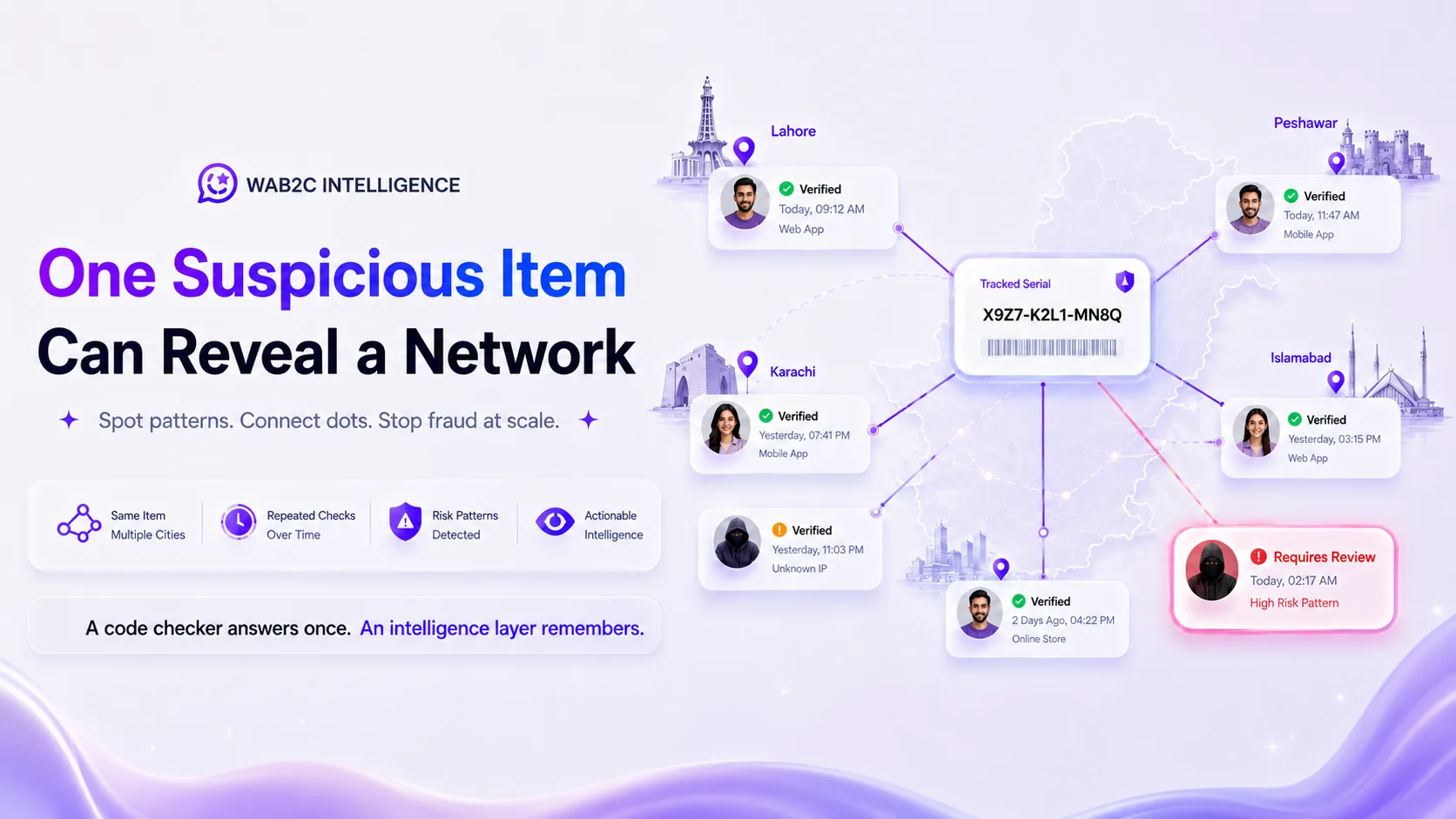
Imagine that one supposedly unique serial is checked seven times by unrelated accounts, in Lahore, Karachi and Peshawar, within two hours, before its batch is officially released, and by sellers outside the intended distribution territory. None of those facts alone proves wrongdoing. Together they justify review.
Signals that should be evaluated together
- Total check count, velocity and intervals between checks
- Same-customer versus different-customer activity
- Coarse region and distance between consented location signals
- Intended distributor territory and channel
- Release, recall, expiry and blocked status at the time of checking
- Seller, receipt, packaging and batch details from related reports
The workflow should say suspicious activity, unusual verification pattern, additional evidence requested or requires review. It should not label a customer, seller or product “counterfeit” solely because a code was repeated.
Team Inbox escalation and case clustering
When risk rules cross a threshold, WAB2C can route the conversation into queues for customer care, quality assurance, regulatory, legal or brand-protection teams. The agent receives the customer thread, serial result, previous history and evidence checklist together, so the customer does not repeat the story.
Related cases can be clustered by serial, batch, seller, market, distributor, region, packaging traits and time window. That turns scattered complaints into a reviewable map: which reports may share a source, where field inspection is most useful and which products or channels deserve attention first.
How WhatsApp verification compares with traditional authentication
A sound anti-counterfeit strategy is layered. WAB2C does not require a brand to abandon physical, regulatory or supply-chain controls; it provides a low-friction customer interface and a connected investigation trail.
Swipe or scroll horizontally to compare all columns →
| Method | Customer effort | Unique-item verification | Repeated-use detection | Media evidence | Investigation trail | Principal limitation |
|---|---|---|---|---|---|---|
| Printed visual cues | Low | No | No | No | No | Customers may not know what to inspect; visible cues can be imitated. |
| Holograms / labels | Low | Sometimes | Not alone | No | Limited | Labels may be copied, imitated or transferred. |
| Static QR / barcode | Low | Usually no | No | No | Basic log | A shared code copies the same experience to every fake. |
| SMS verification | Medium | Yes, with serial | Possible | No | Message log | Rigid format and weak support for rich evidence. |
| Call centres | Medium | Possible | Manual | Separate channel | Agent notes | Time-bound, difficult to scale and prone to transcription errors. |
| Standalone application | High for occasional users | Yes | Yes | Yes | Strong | Download, permissions and unfamiliar-interface friction. |
| RFID / NFC | Low with compatible device | Yes | Yes | No | Strong | Tag, reader and integration cost. |
| Blockchain / distributed ledger | Varies | Record-level | Possible | External | Immutable event log | The ledger cannot by itself prove the physical-digital link. |
| WAB2C + unique item serial | Low | Yes | Yes | Photos, video, receipts, voice | Conversation + case record | Requires secure serialization, governed data and a team ready to act. |
Printed security features work without connectivity. Holograms provide a visible sign. Static QR codes are convenient entry points. SMS reaches basic phones. Call centres offer judgement. Specialist apps suit trained inspectors. RFID and NFC can add strong item identity. Distributed ledgers can make recorded events harder to alter. WAB2C complements these layers by making the customer response and supporting evidence part of the operational record.
One architecture, industry-specific verification rules
The technical pattern can support many products, but the registry fields, customer wording, risk thresholds and escalation teams must reflect each sector.
Pharmaceuticals and medicines
Check product, strength, pack, batch, expiry, release and recall status. A recalled result shows the manufacturer’s approved safety instruction. Verification does not replace DRAP requirements, laboratory testing or medical advice.
Beauty creams and cosmetics
Confirm size, shade or variant and batch. If colour, seal, texture or smell seems unusual, collect packaging photos and purchase details, then compare reports by seller, batch and serial.
Hair oils and wellness
Use an outer serial and, for higher-risk lines, a second protected code inside the cap or carton. Reuse of a single-use inner code is a stronger signal than packaging appearance alone.
Engine oils and lubricants
Confirm grade, pack size, batch and intended territory. A serial allocated to one litre but shown on a four-litre container creates an immediate inconsistency. Collect cap, seal, label and invoice photos.
Genuine automotive parts
Serialize selected bearings, filters, brake and electrical components. Confirm part description and authorised market without claiming that a valid code guarantees compatibility, condition or correct installation.
Degrees, documents and certificates
The issuing institution remains authoritative. Return privacy-limited details such as issuer, credential type, issue date, current status and masked initials—never unrestricted personal records.
Warranties and ownership
Move from verification into legitimate post-purchase value: register a warranty, retain invoice evidence, transfer ownership under policy, deliver care guidance or open a fault report.
Other high-risk branded goods
Apply the model where item identity, distribution territory, customer safety or ownership matter. Controls should follow product risk rather than reuse one generic flow.
The architecture behind the conversation
The customer may see only three or four messages. A credible deployment needs several governed layers behind them.
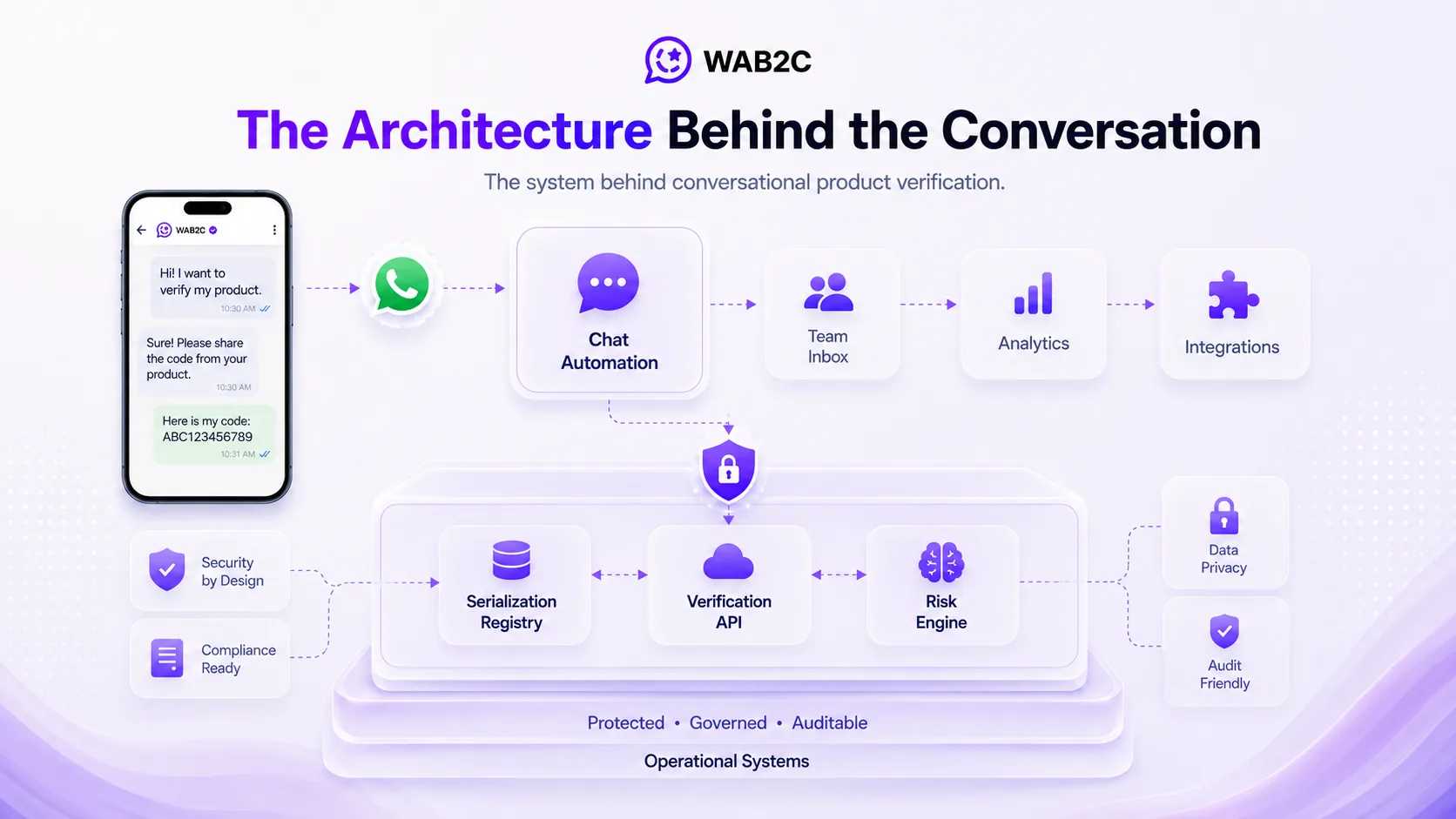
Serialization registry
Stores or imports item-level identifiers and connects them to product, batch, dates, market, channel and status.
Verification API
Validates the request, queries authorised data, applies access rules and records the decision without exposing the internal registry.
Risk engine
Evaluates repeat count, velocity, geography, account diversity, release status, territory and links to existing cases.
WhatsApp automation
Captures the code, returns approved language, requests progressive evidence and keeps the interaction easy to complete.
Team Inbox and case workflow
Assigns responsibility, preserves customer context, adds internal notes and separates customer-care, quality, regulatory and legal access.
Analytics and investigation dashboards
Shows verification volume, unknown codes, repeated serials, high-risk batches, regional clusters, seller patterns and evidence completion.
Integration layer
Connects ERP, manufacturing, distributor, recall, laboratory or credential systems and produces structured exports for authorised teams.
Investigation dashboards and KPIs
A dashboard should help a team decide what to investigate, not reward it for collecting the most data. Useful operational measures include:
- Verification participation by product, market, packaging prompt and channel
- First-check, same-customer repeat, cross-customer repeat and unknown-code rates
- Checks before release, outside territory, after recall and after expiry
- Time from risk signal to triage, customer response and case decision
- Evidence completeness by field and customer drop-off point
- Clusters by serial, batch, seller, distributor, region and packaging characteristic
- Cases requiring regulatory, laboratory, field or legal escalation
Targets should be set from pilot baselines and operating capacity, not copied from unsupported industry claims. A higher suspicious share can mean greater counterfeit pressure, better detection, a poorly tuned rule or a campaign that encouraged more reporting; the number requires interpretation.
From customer media to structured investigation material
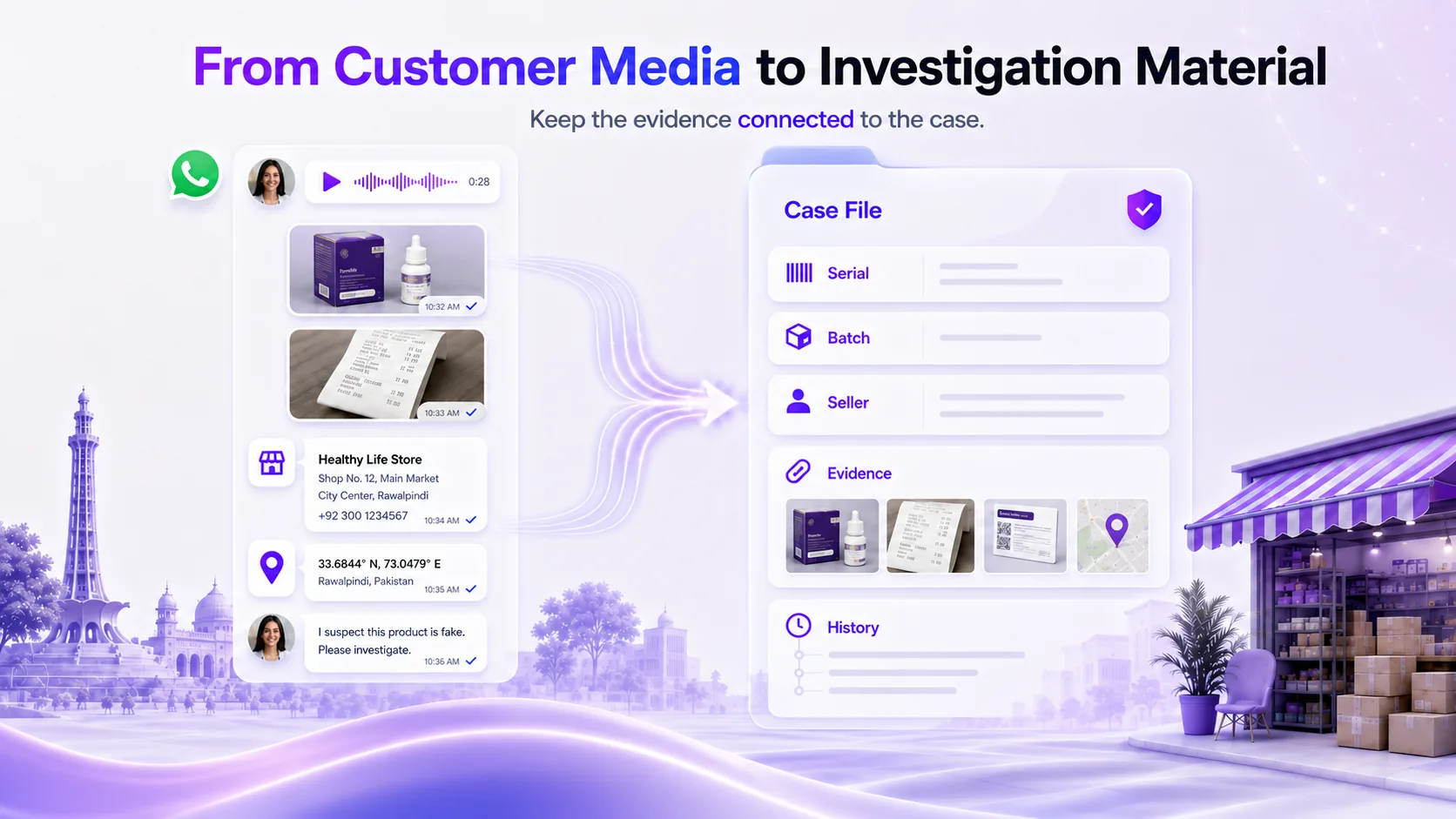
WhatsApp is well suited to collecting the context surrounding a suspicious item. A customer can provide package photographs, receipt, seller details, optional location, video and a voice explanation without moving to a second channel. That material becomes more useful when tied to a preserved verification result and case timeline.
What a structured record should preserve
- Verification timestamp, normalised serial, product and batch
- Status returned at that time and relevant previous-check history
- Original customer-provided files and technical metadata retained under policy
- Seller, purchase and distribution information
- Purpose-specific consent record for optional location
- Conversation events, agent actions, internal notes and escalation history
- Links to related reports and a recorded resolution
Calculator 3
Evidence-readiness score
Review whether a report is captured as a connected operational record.
Evidence readiness
Fragmented
0/100
This score measures operational completeness, not legal admissibility.
Privacy, consent and responsible collection
Collect only what the verification or investigation needs. Explain the purpose before asking for location or identity data. Location should be optional, purpose-specific and consent-based; declining it should not prevent a customer from receiving the safest result the registry can provide. Use role-based access, defined retention periods and deletion procedures. Limit credential responses to the minimum details needed to confirm validity.
Verification is a service interaction and does not automatically create marketing consent. Promotional opt-in should be distinct and should not be a condition of checking a product. The WAB2C Privacy Policy provides the website’s privacy context; each implementing brand remains responsible for its own lawful notices, purposes and data governance.
Operational record is not the same as legal admissibility
Customer reports can support an investigation, but the platform should not promise “court-proof evidence.” Admissibility depends on jurisdiction, authenticity, retention, chain of custody, access controls, forensic handling and legal review. For regulated or high-risk products, laboratory testing and regulator or law-enforcement procedures may still be required.
Responsible limits make the system more credible: WAB2C helps brands recognise patterns sooner and assemble a clearer operational record. It does not replace investigators, laboratories, regulators, courts or professional advice.
Model the business case with your own numbers
A brand does not need questionable market assumptions to begin. The three calculators below accept only visitor-entered values and keep commercial exposure, authentication cost and evidence readiness separate.
Calculator 1
Counterfeit exposure scenario
Use your own assumptions; no industry defaults are preloaded.
Potential gross commercial exposure
0
Projected verification events
0
Projected evidence-bearing signals
0
Scenario estimate — not a forecast or confirmed loss.
Calculator 2
Authentication cost comparison
Enter quotes or internal costs in one consistent currency.
| Protection layer | Setup | Annual fixed | Per unit | First year | Recurring/year | Per shipped unit | Per verification |
|---|---|---|---|---|---|---|---|
| Hologram or security label | 0 | 0 | — | — | |||
| Secure print or tamper feature | 0 | 0 | — | — | |||
| RFID/NFC | 0 | 0 | — | — | |||
| Unique serial plus WAB2C verification | 0 | 0 | — | — |
These layers may complement one another. Compare combinations as well as individual line items.
Commercial and operational benefits
Potential benefits extend beyond a per-label calculation: easier public participation, earlier visibility of copied codes, faster recall communication, more consistent customer guidance, less fragmented evidence, clearer field priorities and stronger coordination between support, quality, distribution, regulatory and legal teams.
None should be presented as a guaranteed saving or reduction. A controlled pilot should establish actual participation, evidence completion, response time, investigation usefulness and operating cost for the chosen product and market.
Packaging opportunity and legal boundary
There is useful simplicity in printing a readable unique serial, an optional QR or Data Matrix, and one instruction: Verify on WhatsApp before use. That can reduce competing authentication directions and lead customers to one official conversation.
It does not mean regulated packaging can be reduced to a barcode. Medicines, cosmetics, automotive fluids, food, chemicals and other products may be required to show ingredients, warnings, batch, expiry, manufacturer, importer, licensing information or standards marks. Tamper evidence and physical security can remain legally required or commercially valuable. The opportunity is to simplify the verification experience, not remove mandatory safety and regulatory information.
A controlled implementation roadmap
01
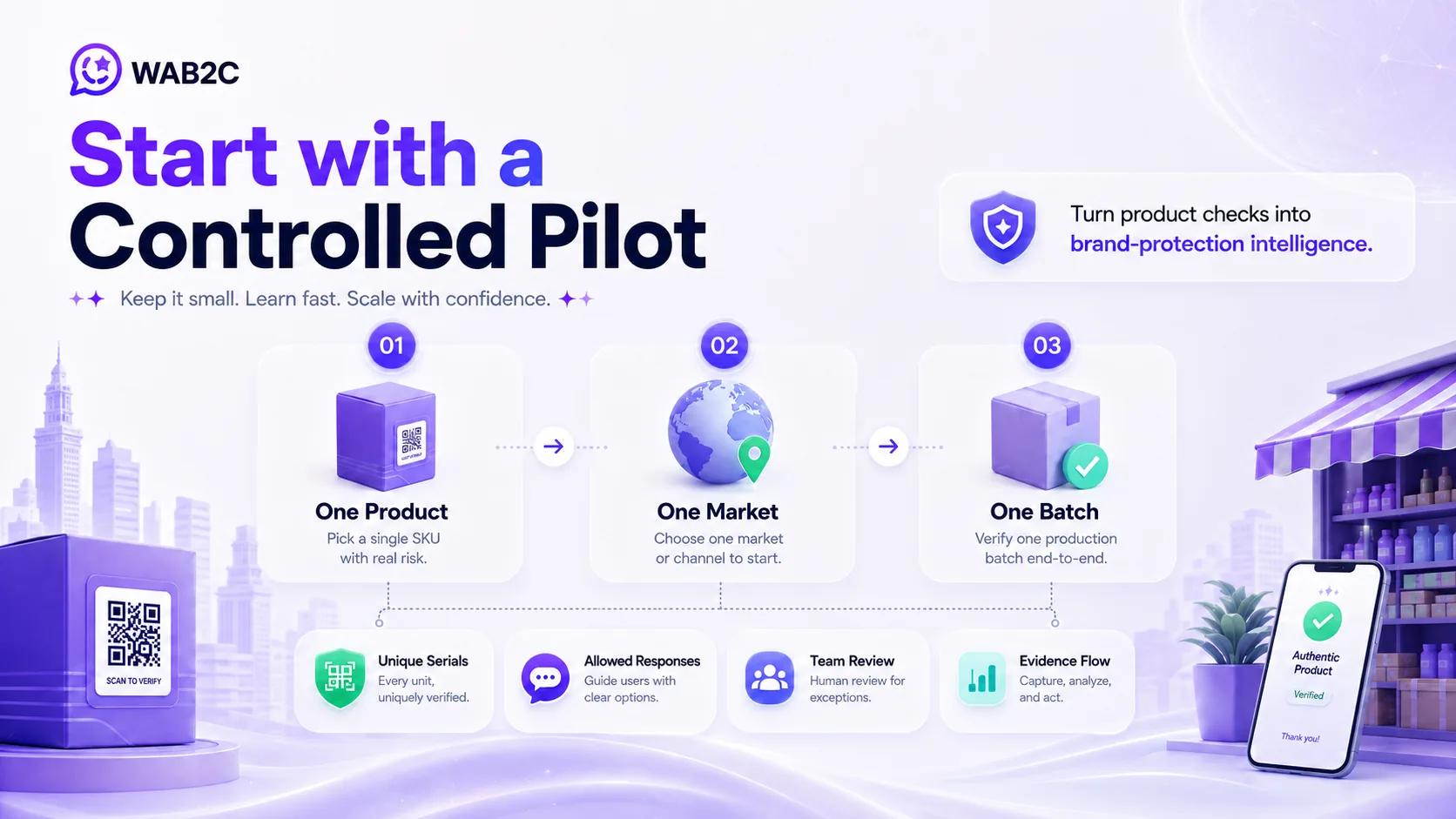
Choose a narrow pilot
Select one high-risk product, one market and one controlled batch. Define what success and safe failure look like.
02
Prepare authoritative data
Confirm product, batch, dates, territory, release, recall and blocked fields; resolve ownership and data quality issues.
03
Generate secure serials
Use sufficiently unpredictable item-level identifiers, protected generation, controlled printing and reconciliation.
04
Design customer language
Write short approved responses for every state, including medicine safety wording, evidence requests and response times.
05
Configure risk rules
Test first checks, same-customer repeats, cross-customer repeats, velocity, geography, inactive stock and recalls.
06
Build the human workflow
Assign queues, roles, service levels, field-review triggers, retention and regulator or legal escalation criteria.
07
Test abuse and privacy
Exercise guessed codes, bulk attempts, data overexposure, location refusal, media failures and accessible fallbacks.
08
Measure before scaling
Review participation, false positives, evidence completion, case usefulness and operational load before adding products.
Customer education completes the design. The official WhatsApp number should appear consistently on packaging, the brand website, invoices and authorised-retailer material. Tell customers that unique serials are monitored for reuse. A copied code then creates more than another page view—it can create a connected signal.
The operating principle
The investigation starts with one item. The deterrence grows with every connected check.
Frequently asked questions
Can WhatsApp itself authenticate a physical product?
No. WhatsApp is the customer-facing interface. The connected product registry, verification API and brand-approved rules remain the source of truth. WAB2C connects the conversation to those systems and manages the guided workflow.
Does a repeated serial prove that a product is counterfeit?
No. A repeat can result from a retailer demonstration, a family recheck, a field audit or a copied code. It is a risk signal that should be interpreted with timing, location, customer diversity, seller data, photographs and other context.
Why is a unique serial stronger than a static QR code?
A static QR typically identifies a product type or opens the same page for every unit. A unique serial identifies one saleable item, so its first check, later checks and status history can be evaluated individually. The serial can still be copied, which is why repeated-use intelligence matters.
Can WAB2C replace pharmaceutical regulation or laboratory testing?
No. Product verification supports customer guidance, reporting and investigation. It does not replace DRAP requirements, professional medical advice, authorised distribution controls, laboratory analysis, recalls, regulator action or law-enforcement procedures.
What evidence can a WhatsApp verification flow collect?
With clear purpose and consent, a flow can request package and code photographs, a receipt, seller and purchase details, optional location, video, text and voice notes. The business should preserve the registry result, timestamps, consent, agent actions and links to related cases under an approved retention policy.
Does product verification create permission for marketing messages?
No. A customer asking to verify a product has not automatically consented to marketing. Verification, service updates and promotional consent should be separated and handled under applicable privacy and WhatsApp messaging rules.
What is the safest way to start?
Begin with one high-risk product, one market and one controlled batch. Validate the registry, statuses, repeat rules, evidence checklist, privacy controls and human escalation before expanding to more products or territories.
Sources and further reading
The editorial foundation and image sequence come from the website owner’s published Medium article. Technical and public-interest context is linked to primary or authoritative sources below.
- M M Alam on Medium — The next anti-counterfeit interface is already on your customer’s phone
- World Health Organization — Substandard and falsified medical products
- OECD/EUIPO — Mapping Global Trade in Fakes 2025
- U.S. FDA — DSCSA product identifier requirements
- GS1 — Global Traceability Standard
- European Commission — Falsified Medicines Directive and safety features
- DRAP — Recall and rapid alerts
- INTERPOL — Pharmaceutical crime operations
- Meta — WhatsApp reach and voice-message usage
- WAB2C — Provider Disclosure and Privacy Policy
WAB2C PRODUCT VERIFICATION
Stop Checking Products One by One. Start Mapping the Network Behind the Fakes.
The first suspicious item should not disappear into a complaint log. Connect unique product serials, WhatsApp verification, repeat-check intelligence, customer evidence and human investigation in one guided system.
Start with one product, one market and one controlled verification pilot.
Related WAB2C resources
WhatsApp Coexistence
Learn how one number can support familiar business-app use alongside API automation.
ExploreWhatsApp Business API Approval
Understand onboarding, provider roles and a compliant implementation path.
ExploreWhatsApp for Public Services
See how governed WhatsApp workflows can support complex service environments.
Explore