
Ayesha's operating note
Ecommerce automation is not successful because every event sends a message. It is successful when the customer receives the right next step and the business still knows who owns the order.
01 — The connected model
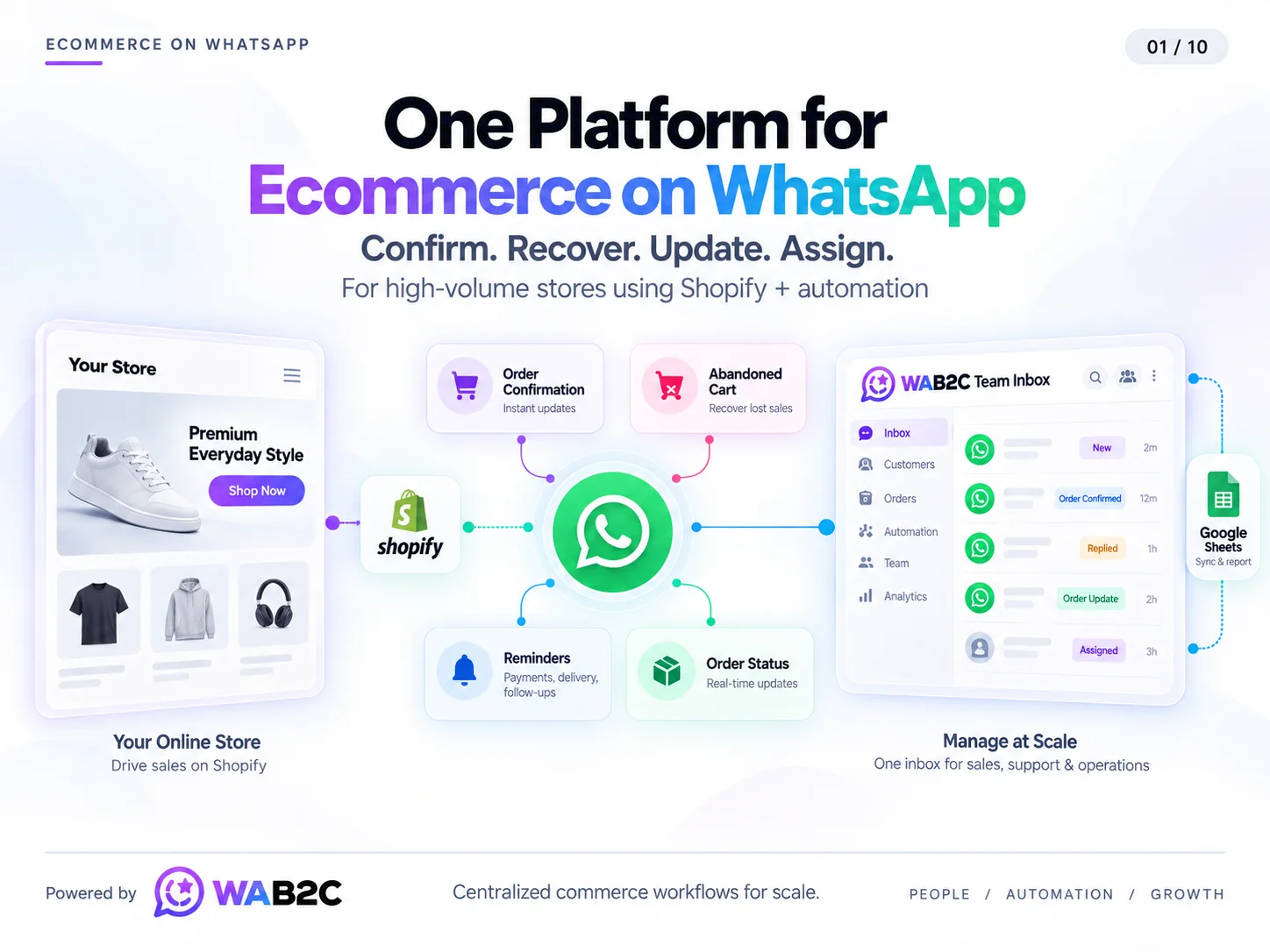
Your store needs an operating system for conversations
An ecommerce store already has products, customers, orders, payments, fulfilment states and returns. WhatsApp adds a fast, familiar customer channel—but speed alone does not create control. If agents copy order numbers into personal chats, support checks status in a second tab and operations maintains a separate sheet, the business has simply moved fragmentation into a more popular inbox.
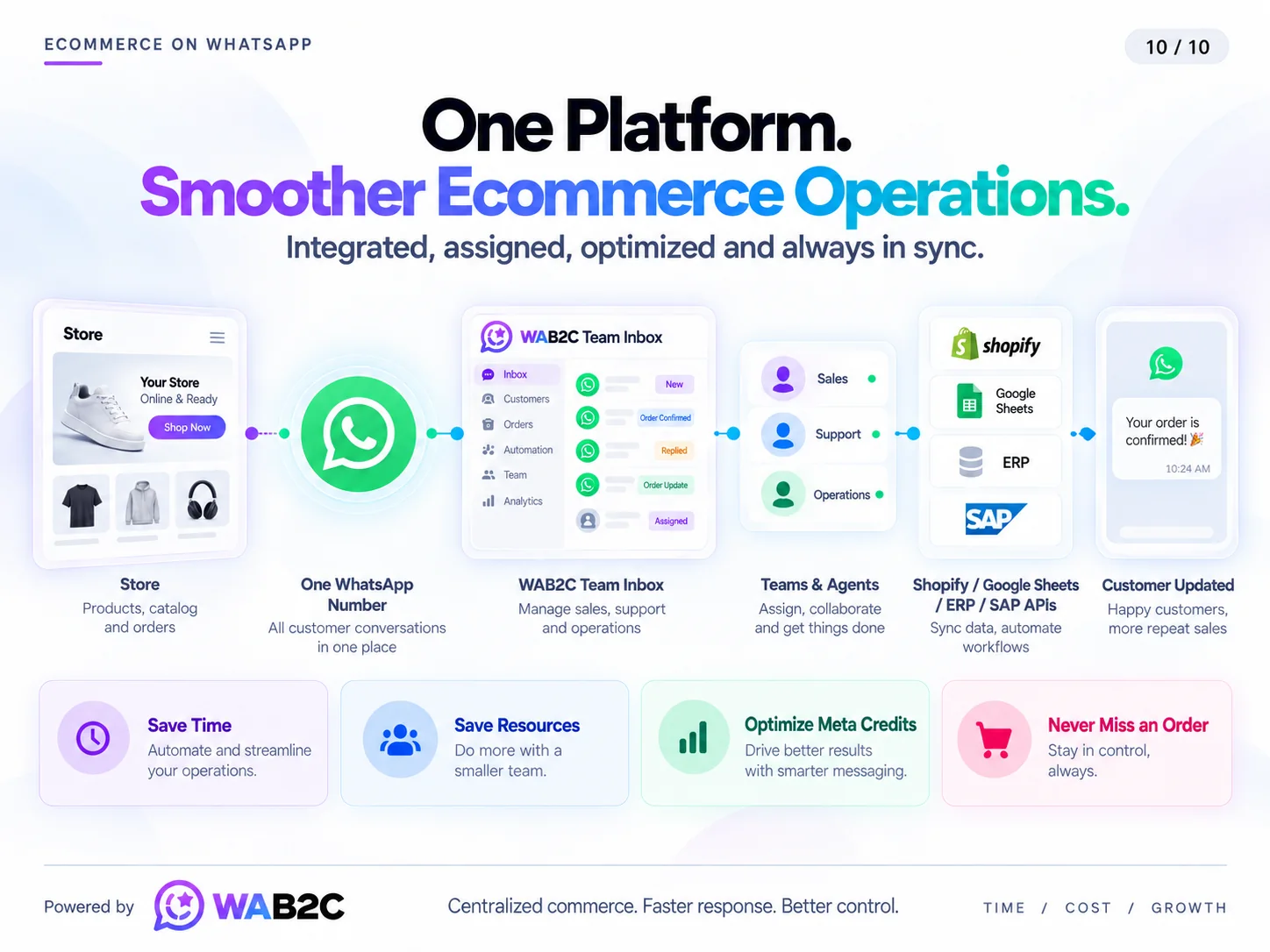
A connected model gives each system a clear responsibility. Shopify or another commerce platform owns the commercial order. A payment provider confirms payment. A warehouse or ERP owns fulfilment. WAB2C coordinates the conversation, captures structured intent, applies routing and automation rules, and keeps human handover visible. Google Sheets may provide an operational view, but it should not silently become a second order database.
Store
Products, carts, customers and orders
Customer questions and guided actions
WAB2C
Flows, routing, ownership and automation
Business systems
Payment, inventory, fulfilment and reporting
02 — A useful distinction
WhatsApp Flows and automation flows are not the same thing
In 2026, the word flow can describe two different layers. WhatsApp Flows are structured, customer-facing experiences that let a person complete steps inside WhatsApp. They can be useful for guided choices, sign-ups, requests, appointments or other structured tasks supported by the platform.
An automation flow is the wider business logic around that experience. It can listen for an order event, check a condition, select a message, launch a customer-facing Flow, assign the reply, update a tag and escalate an exception. The first layer is what the customer sees. The second layer is how the business remains coordinated.
Customer-facing WhatsApp Flow
Collects structured choices or information inside the WhatsApp experience.
Operational automation flow
Connects triggers, data, decisions, assignments, updates and human escalation.
03 — Customer access
One official entry point needs a clear promise
One WhatsApp number can become the front door for product questions, cart help, payment confirmation, order status, delivery changes, returns and support. The value is not the number itself. The value is that every entry route has a defined next action and an accountable owner.
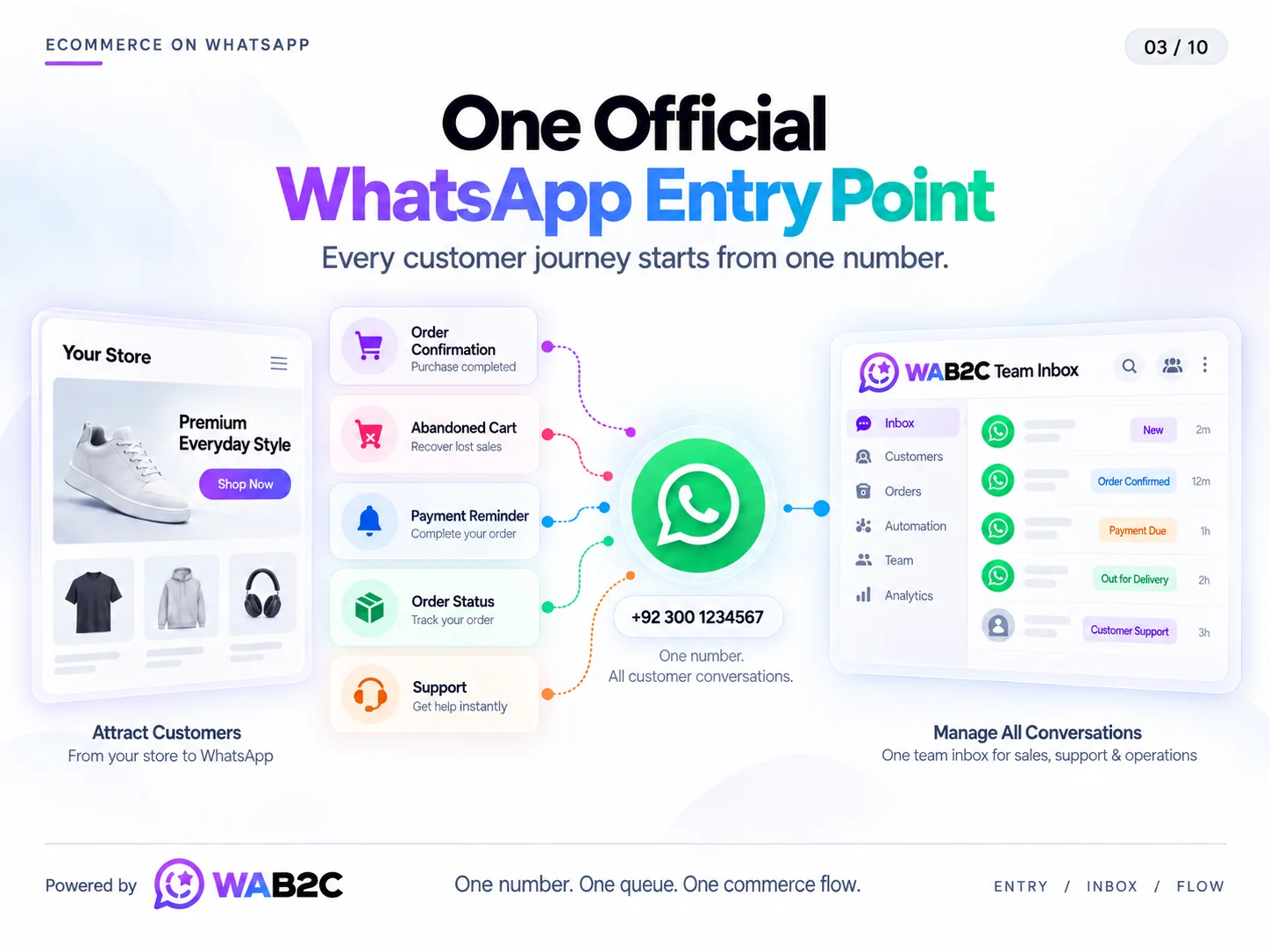
Start with a short menu or intent detector that reflects what customers actually need. Avoid a long list of departments. “Shop products”, “Complete my order”, “Track my order” and “Get help” are customer outcomes. “Sales”, “Ops” and “Tier 2” are internal labels that belong behind the experience.
04 — Clear ownership
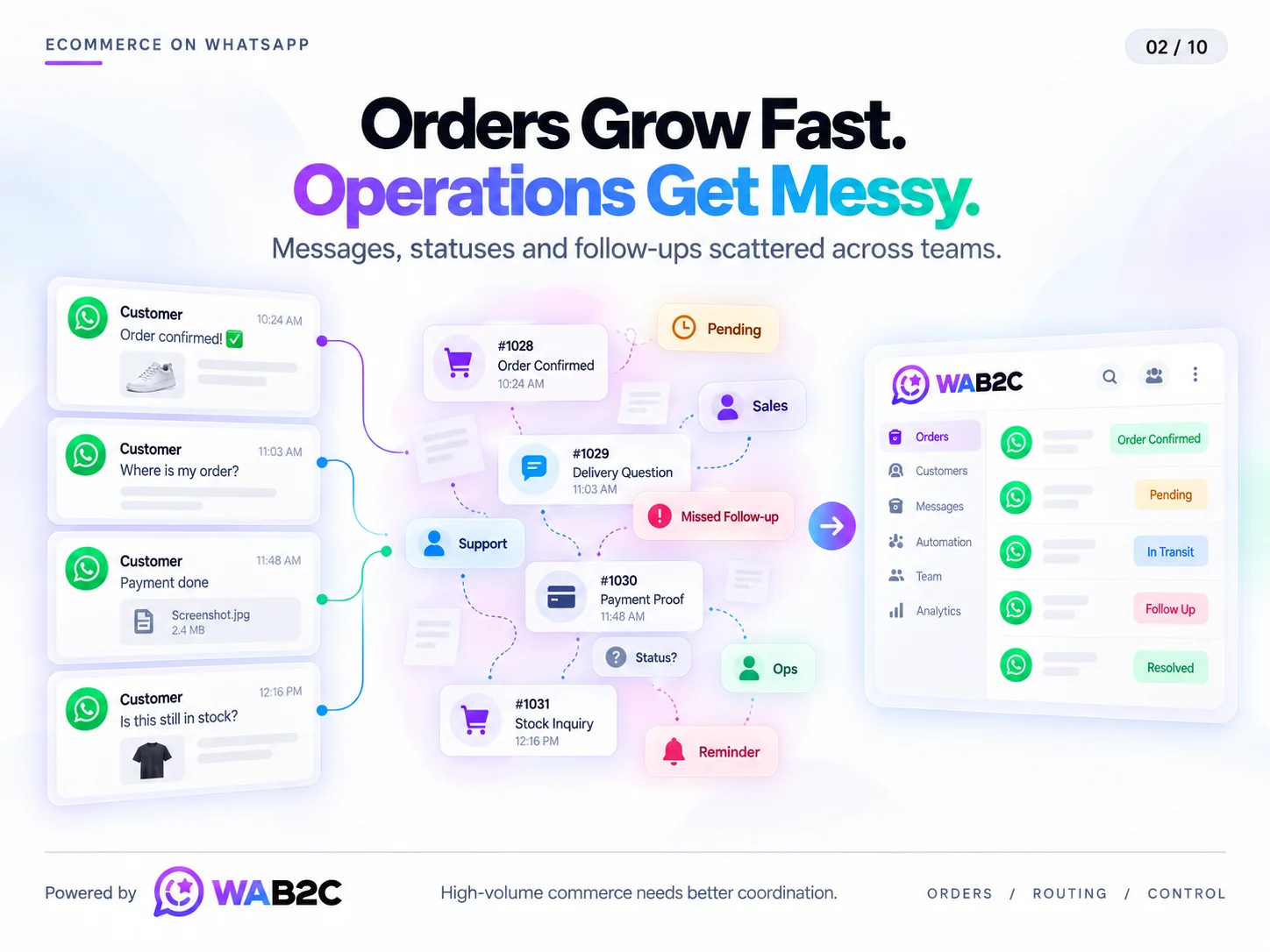
Smart routing means the right order reaches the right owner
Routing should use the smallest reliable set of signals: customer intent, order state, language, brand or store, region, priority and existing ownership. A pre-purchase product question may go to sales; payment evidence to confirmation; a delivered-but-missing order to support; a chargeback or safety issue to escalation.
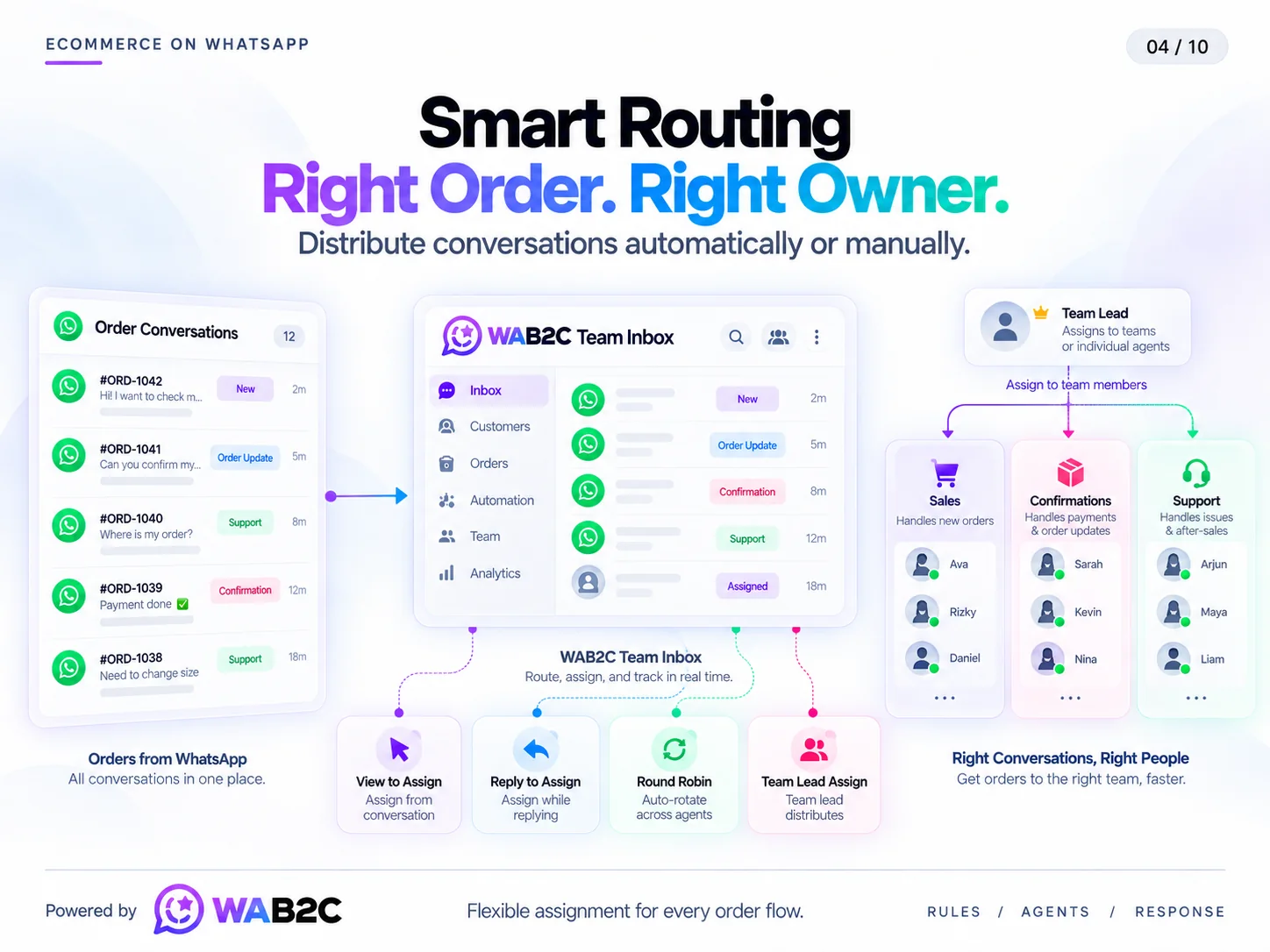
Inside the WAB2C Team Inbox, assignment can be manual, rules-based, round-robin or managed by a team lead. The best method depends on volume and specialisation. Whatever the method, define what happens when nobody accepts the conversation, an agent becomes unavailable or the request crosses a time threshold.
Intent
What is the customer trying to complete?
Context
Which order, store, market or product is involved?
Owner
Which person or team can act, not just reply?
Escalation
What happens if the expected path fails?
05 — Store integration
Shopify actions should follow trusted commerce events
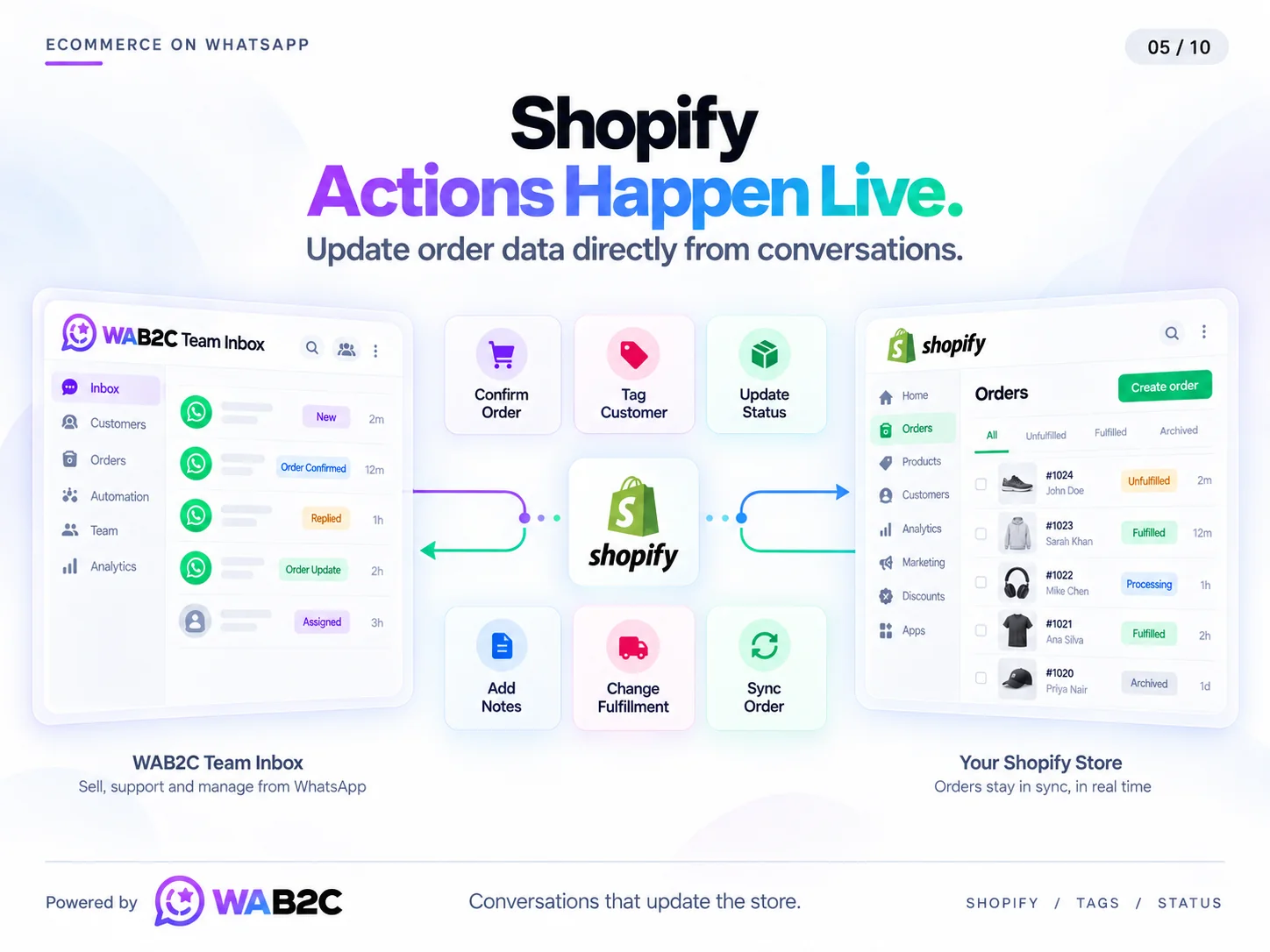
Shopify supports event-driven integration through webhooks and controlled order access through its APIs. Its official webhook documentation explains how apps can receive store events, while the GraphQL order documentation describes order data and access requirements.
The integration should be specific. An order-created event might confirm receipt. A fulfilment event might prepare a shipping update. A customer reply might add a controlled note or tag after validation. Higher-risk actions—refunds, address changes after dispatch, order cancellation or payment disputes—should normally use explicit verification and human approval.
Event does not automatically mean message
First decide whether the customer needs the update, whether the data is final, which category or template applies and whether a person should review the action.
06 — Shared vocabulary
Order statuses and reporting must mean the same thing everywhere
“Confirmed” can mean payment accepted to finance, inventory reserved to operations and acknowledgement sent to support. If teams use the same word for different events, automation becomes dangerous. Define a canonical status model and map each system to it.
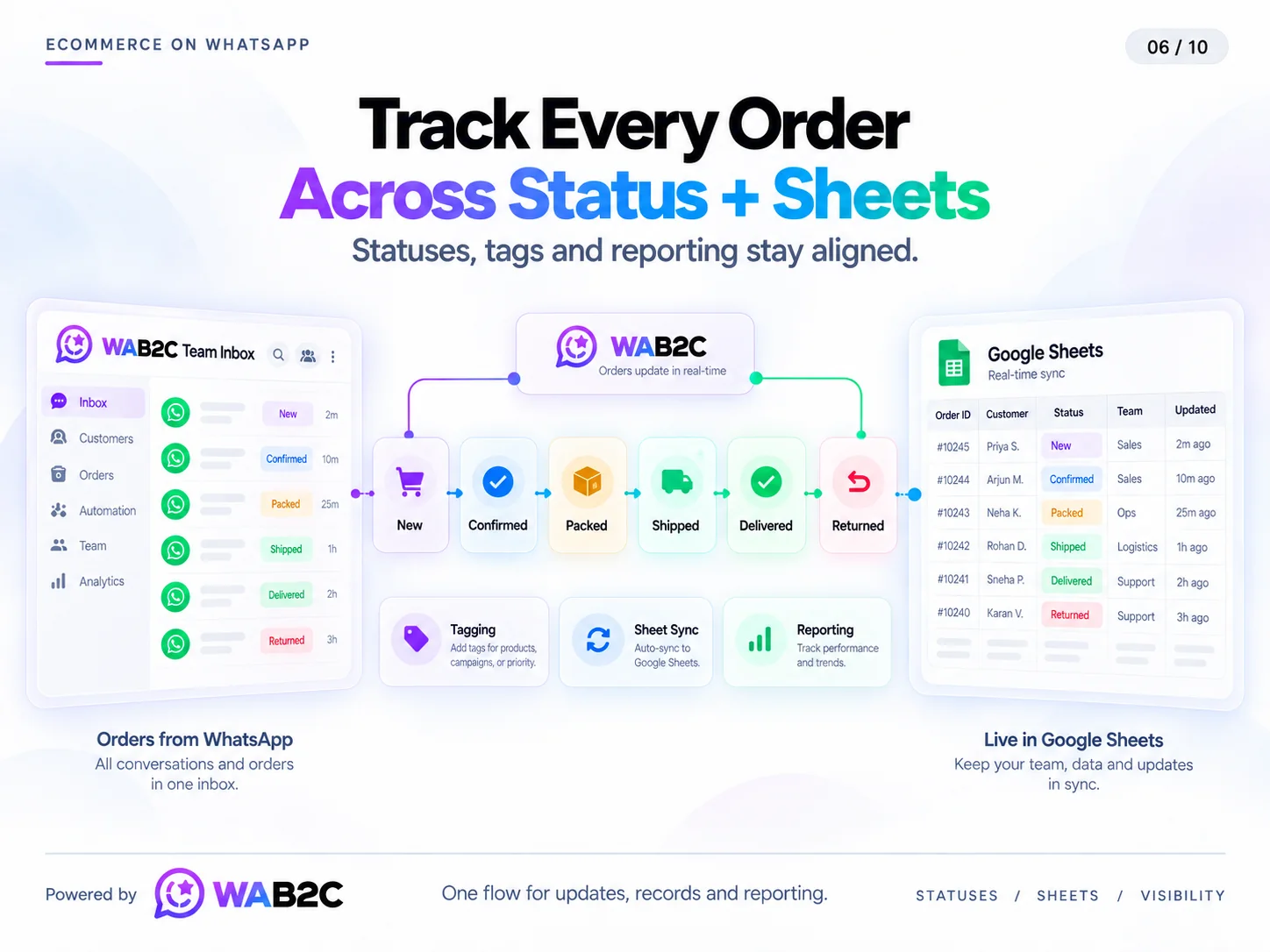
A simple model might include new, confirmed, packed, shipped, delivered, return requested and returned. Each status should have an authorised source, time stamp, allowed transitions and customer-facing wording. The Google Sheets API can read and write spreadsheet data for approved reporting workflows, but access scopes, quotas, privacy and data ownership still require deliberate design.
Source
Which system is authorised to create this status?
Transition
Which previous and next states are valid?
Communication
What should the customer see and when?
07 — Helpful follow-up
Cart recovery is a journey, not a reminder blast
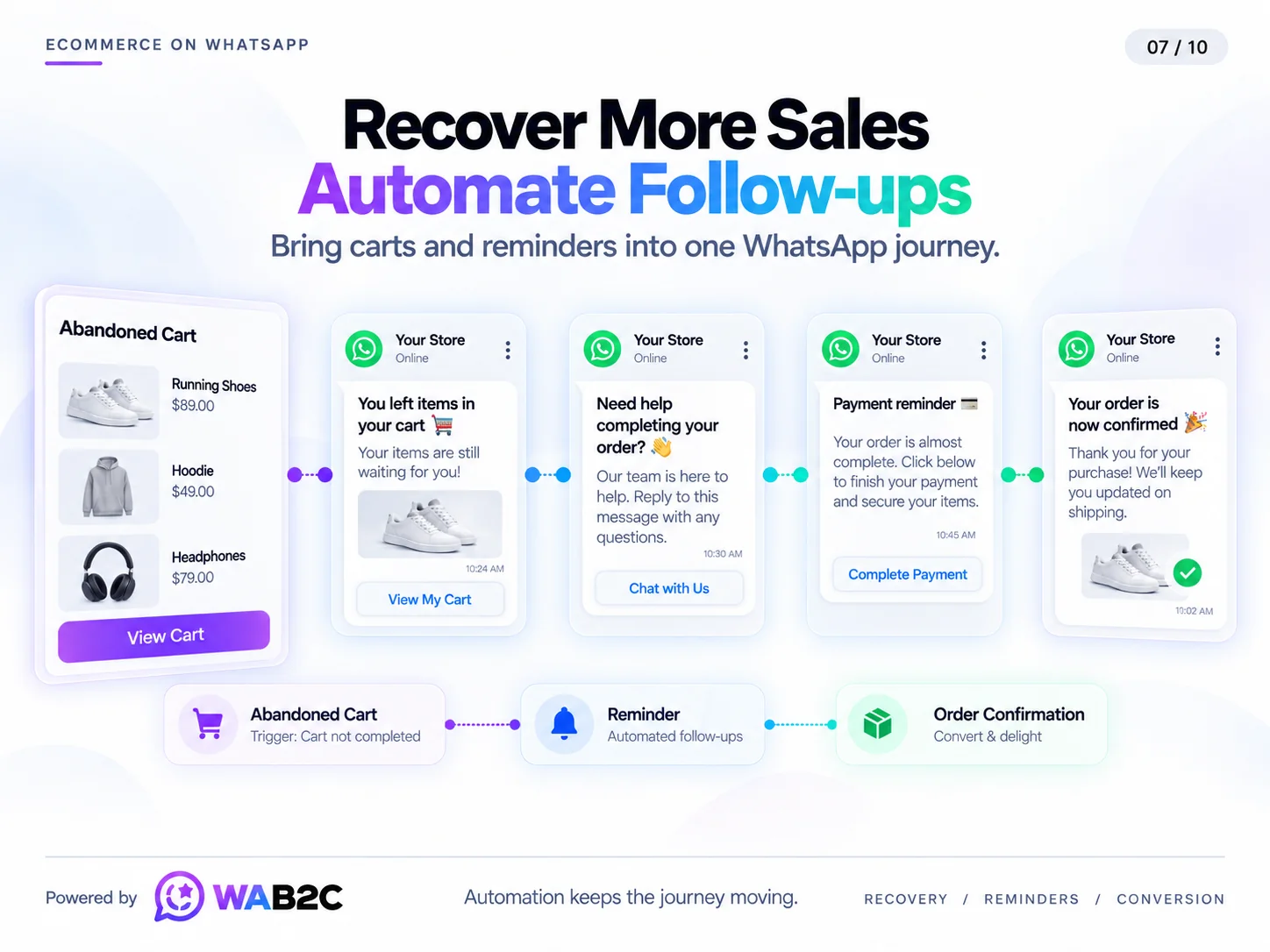
A cart can be abandoned because the customer became distracted, could not use a payment method, needed a size answer, lost trust in delivery timing or decided not to buy. Sending the same discount to every cart treats those reasons as identical.
Build a short sequence around help. Confirm that the cart is still relevant, offer the saved items, make human assistance available, explain the next payment step and stop the journey when the order completes. Use the appropriate consent and message mechanism, respect opt-outs and set a frequency limit. A recovered order is useful; a frustrated subscriber is not.
A better recovery sequence
Context → Help → Payment path → Confirmation → Stop
Do not keep sending recovery prompts after conversion, explicit refusal, opt-out or the configured journey limit.
08 — Operational scale
High volume needs queues, service levels and exception design
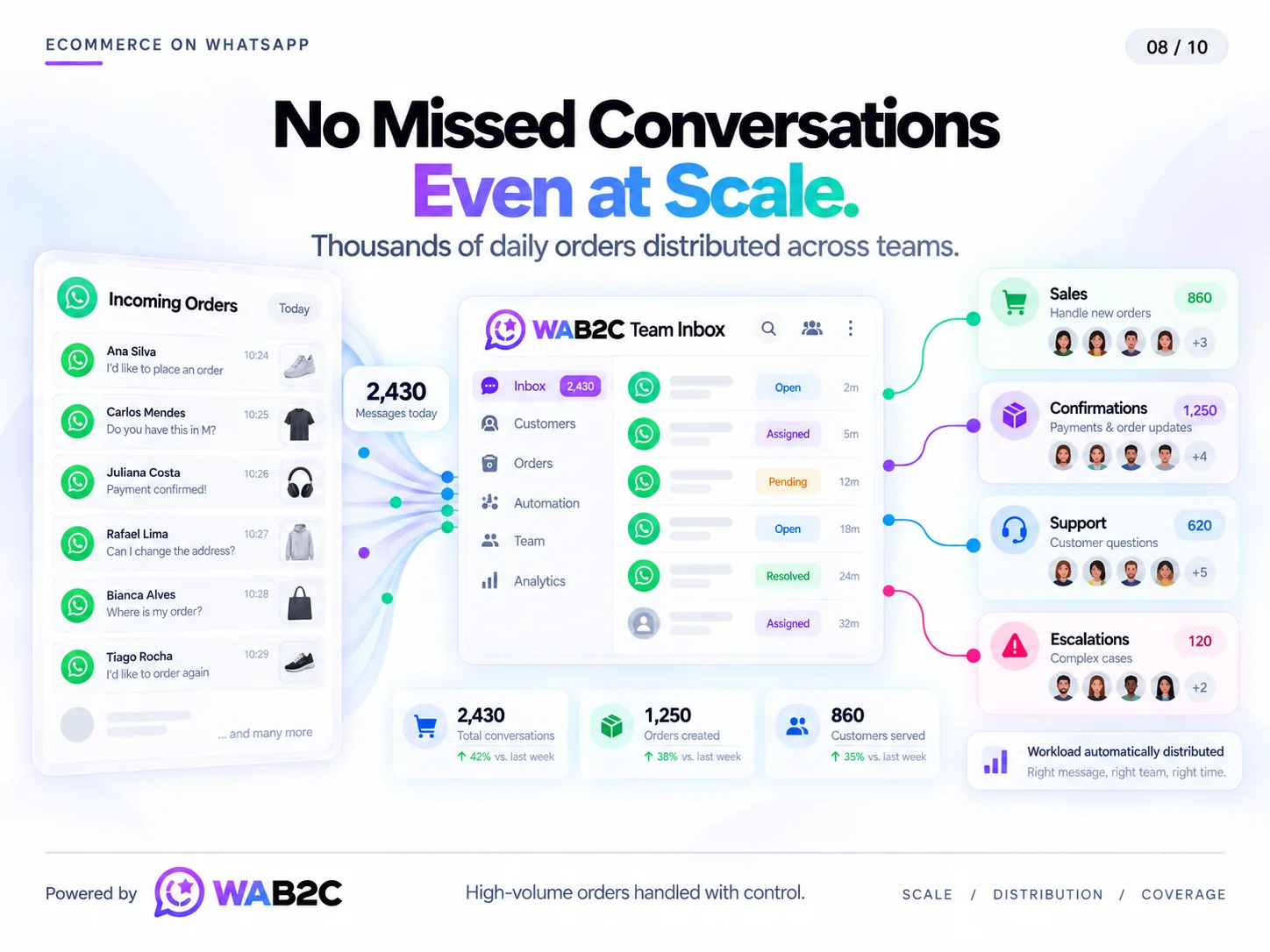
At scale, the biggest risk is not that a bot fails to answer a common question. It is that a payment issue, cancellation, delivery exception or angry customer remains invisible inside a busy queue. Separate work by intent and risk, then give each queue an owner, response expectation and escalation path.
Useful measurements include first useful response, unassigned conversations, transfer rate, unresolved age, order-confirmation completion, recovery conversion, delivery exceptions, repeat contacts for the same order, opt-out signals and data mismatches between the chat and source system. Message count by itself is an activity metric—not an ecommerce outcome.
Automation should make unresolved work more visible, not merely make sent-message volume look impressive.
09 — Cost-aware design
Smarter messaging improves clarity before it improves cost
WhatsApp Business Platform pricing depends on the current model, recipient market, message category and delivery. The official WhatsApp Business Platform pricing page should be the reference point for current rules. WAB2C plan, provider, integration and third-party system charges may be separate.
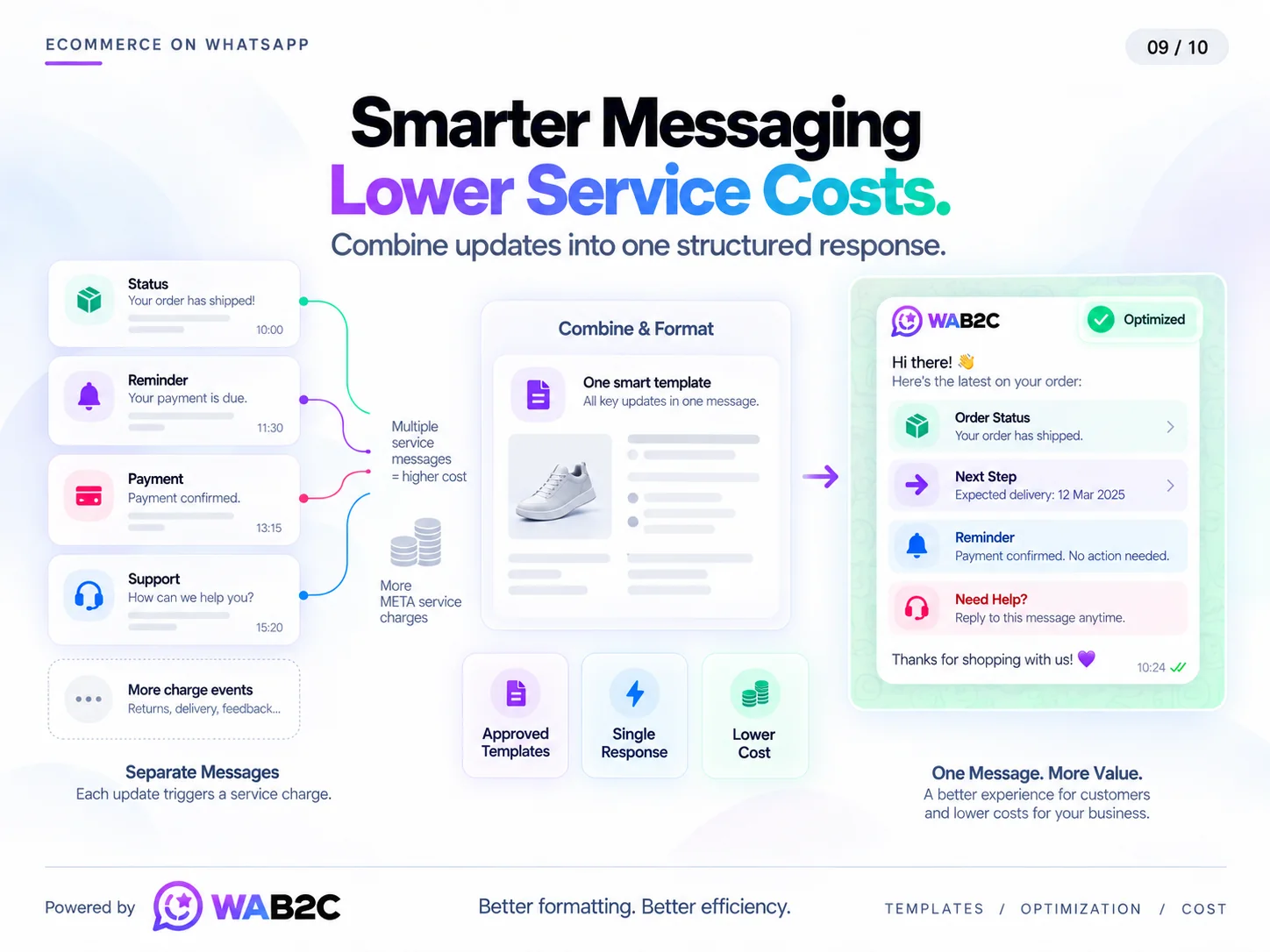
Cost optimisation begins with message architecture: remove duplicate events, suppress unchanged statuses, avoid sending internal labels to customers, select the correct purpose and provide one useful next step. Combining four updates into one message is not automatically better; it is better only when the information belongs together and reaches the customer at the right time.
Expensive behaviour
Duplicate triggers, unnecessary status chatter, wrong categories, repeated questions and messages that create another support contact.
Efficient behaviour
Trusted events, relevant timing, clear formatting, one next action, suppression rules and a direct path to human help.
10 — Controlled implementation
Build one complete journey before connecting everything
The final architecture may include a store, one WhatsApp number, WAB2C Team Inbox, sales, support and operations teams, Shopify, Sheets, ERP, SAP or custom APIs. Do not integrate all of them merely because the diagram looks complete. Begin with one customer outcome and connect only the systems that own its decisions.
Choose one outcome
For example: reduce unresolved payment-confirmation requests without duplicating order data.
Map the customer path
Write the shortest useful path from trigger to completed action, including failure and opt-out.
Name every source of truth
Decide which system owns the order, payment, inventory, fulfilment and customer permission.
Design Flow, routing and handover
Separate structured customer steps from internal automation and accountable human decisions.
Test state changes and duplicates
Replay late events, retries, missing data, concurrent replies and out-of-order updates.
Measure the outcome
Compare completion, response, unresolved work, data accuracy, cost exposure and customer effort.
Ecommerce pilot readiness checklist
The customer outcome and start event are defined.
Store, payment and fulfilment ownership are explicit.
Consent, message purpose and opt-out are designed.
Every queue has an owner and escalation path.
Duplicate, delayed and failed events are tested.
Success is measured beyond message volume.
Practical answers
Frequently asked questions
Can an ecommerce store connect Shopify with the WhatsApp Business API?
Yes, when the required Shopify permissions, supported API or webhook events, WhatsApp access and implementation scope are available. The integration should exchange only the fields needed for the workflow, while Shopify remains the authoritative commerce record.
Are WhatsApp Flows the same as WAB2C automation flows?
No. WhatsApp Flows are customer-facing structured experiences inside WhatsApp. An automation flow is the wider business logic that can receive events, apply conditions, update systems, assign work and decide when to send a Flow or hand the conversation to a person.
Can customers complete an entire ecommerce purchase inside WhatsApp?
The answer depends on the catalogue, payment provider, market, available WhatsApp features and store architecture. A Flow can collect structured choices, but checkout, payment and final order creation may still happen through Shopify or another authorised system.
Can one WhatsApp number handle sales, order confirmation and support?
One customer-facing number can route several intents to configured teams and workflows. Eligibility, display name, number setup and platform access must be confirmed during onboarding.
Can a store send abandoned-cart reminders on WhatsApp?
A configured recovery journey can be used when the business has the appropriate customer permission, an eligible message purpose and any required approved template. It should stop after conversion, opt-out or the defined recovery limit.
Should Google Sheets become the source of truth for orders?
Usually not. Sheets can support operational visibility, controlled reporting or a temporary workflow, but the store, ERP or order-management system should normally remain the source of truth for inventory, payment, fulfilment and returns.
Does combining order updates always reduce WhatsApp costs?
No. Clearer message design can reduce unnecessary repetition, but actual charges depend on the message category, recipient market, delivery, timing and current platform rules. Review the latest official pricing and your provider terms before forecasting.
Connect one customer outcome
Turn store events into accountable customer journeys.
Explore the WAB2C ecommerce solution, compare current plans or bring one order, recovery or support workflow to the team.
About the author
Ayesha is Digital Manager at WAB2C. She focuses on how customer journeys, campaign intent, consent, content and operational ownership come together—so automation remains useful to the customer and manageable for the business.
Editorial and provider disclosure
This article explains practical operating patterns and does not claim customer results. Dashboard figures, telephone numbers, names, messages and order examples in the visuals are illustrative. Product capabilities depend on the agreed implementation, available APIs and third-party permissions. WAB2C is an independent automation and implementation platform operated by Alams Innovate Private Limited. WhatsApp Business Platform access is provided through applicable authorised provider channels and remains subject to Meta and provider requirements. Shopify, Google Sheets, SAP, Meta and WhatsApp are trademarks of their respective owners; references describe compatible workflows and do not imply ownership or endorsement.